 CNC ELECTRIC GROUP ZHEJIANG TECHNOLOGY CO.,LTD
 Products
 Projects
 Solutions
 Service
 News
News About CNC
 Contact Us
Stable voltage is the foundation of any reliable power system. When voltage drops or spikes, it can damage equipment, cause downtime, and cost your business a lot of money. The key to managing this problem lies within the transformer itself.
A transformer tap changer is a device that adjusts the transformer’s turns ratio, giving you precise control over its output voltage.
This guide covers the two main types: De-Energized Tap Changers (DETC) and On-Load Tap Changers (OLTC). Knowing the difference between them is essential for good system design.
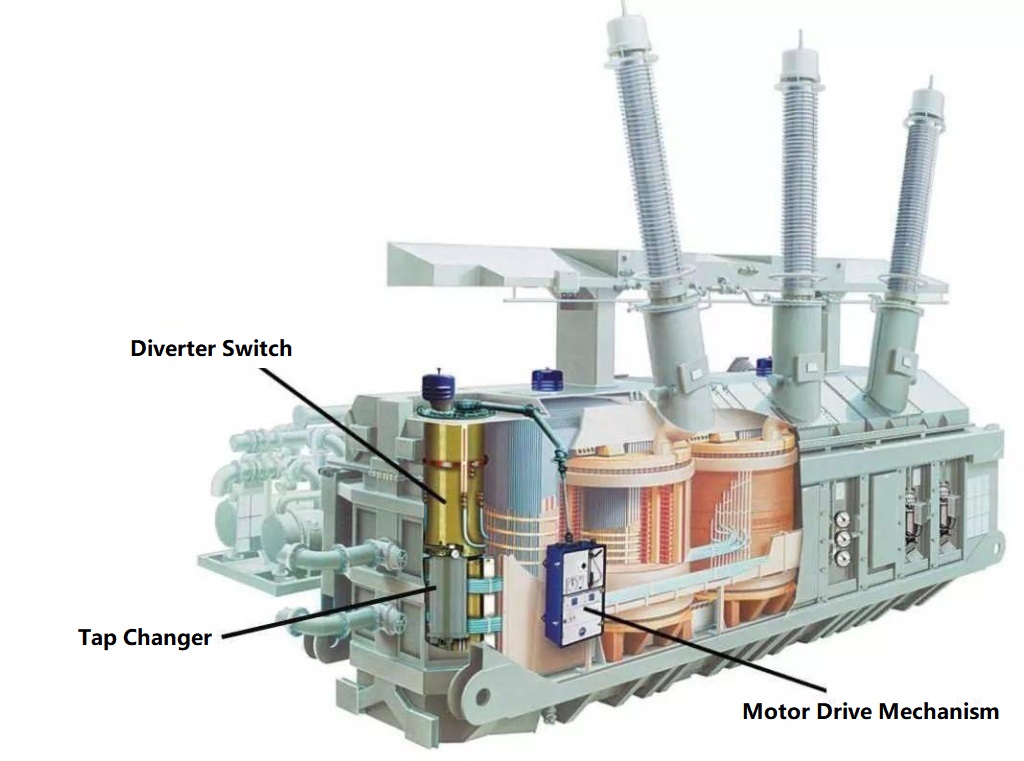
How Transformer Taps Adjust Voltage
A transformer works on a simple principle: the turns ratio. This relationship is shown by the formula:
Vp/Vs = Np/Ns
A tap changer works by changing the transformer’s turns ratio. It does this by connecting to different points, called “taps,” on a winding, which changes the number of active turns, usually on the high-voltage side. This directly controls the secondary voltage output.
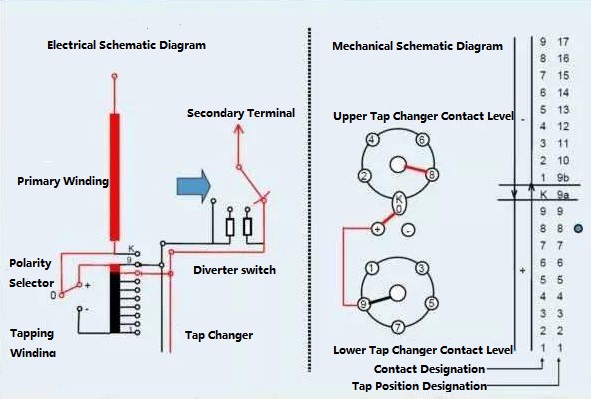
De-Energized Tap Changers (DETC)
A De-Energized Tap Changer (DETC), also called an Off-Circuit Tap Changer (OCTC), is the most basic type of voltage control. Its name tells you the most important rule for using it: you must completely shut down and disconnect the transformer before making any adjustment.
Key characteristics include:
- Operation: Manual adjustment done during a planned shutdown.
- Frequency of Use: Not often, typically for seasonal load changes or long-term grid voltage fixes.
- Complexity: A simple, strong, and very reliable mechanical switch.
- Cost: Much lower upfront cost compared to an OLTC.
These devices use common tap arrangements that adjust voltage in steps, such as ±2.5% and ±5% of the rated voltage.
On-Load Tap Changers (OLTC)
An On-Load Tap Changer (OLTC) is a more advanced solution for managing voltage in real time. Its main advantage is that it can adjust the turns ratio while the transformer is running and supplying power, so there is zero interruption to your load.
This works through a complex system of diverter switches and transition resistors or reactors, which control the current and stop arcing during a tap change. It is a much more involved process than what a DETC does.
Key characteristics include:
- Operation: Automatic or remote-controlled, working in real time under load.
- Frequency of Use: Very frequent, providing constant regulation for changing loads or unstable grid conditions.
- Complexity: A sophisticated mechanism with more moving parts that needs more maintenance.
- Cost: Much higher upfront cost and a larger ongoing maintenance budget.
An On Load Tap Changing Transformer is essential for large power grids, especially those that use renewable energy sources.
DETC vs OLTC: A Head-to-Head Comparison
Choosing between a DETC and an OLTC depends entirely on what your application needs. The table below gives you a clear, side-by-side look at both options.
| Feature | De-Energized Tap Changer (DETC) | On-Load Tap Changer (OLTC) |
|---|---|---|
| Operation Condition | Must be de-energized (offline) | Operates under load (online) |
| Adjustment Speed | Slow (requires downtime) | Fast (real-time adjustments) |
| Application | Distribution transformers, industrial sites with stable loads | Power/transmission transformers, critical facilities (hospitals, data centers), grids with renewables |
| Complexity & Cost | Simple & Low Cost | Complex & High Cost |
| Maintenance | Minimal | Regular, more intensive |
| System Impact | Requires planned service interruption | No interruption to power supply |
The table makes the technical differences easy to see. Browsing a wide catalog of tap changing transformers can help you match these specs to real products and your budget.
Choosing: DETC or OLTC?
The right choice comes down to four key questions. We use this checklist to help our clients find the most effective and affordable solution.
How variable is your load?
If your load is stable or changes on a predictable seasonal schedule, a DETC is often enough. If your load changes constantly and without warning, like in a facility with arc furnaces or large motors starting up, you need an OLTC for real-time correction.
Can you tolerate downtime?
This is a critical business question. If shutting down the transformer for a manual tap adjustment is not possible—for example, in hospitals, data centers, or factories that run around the clock—an OLTC is the only real option.
What is your budget?
An OLTC can cost two to three times more than a DETC upfront. However, you need to think about this as a CAPEX vs. OPEX decision. The cost of downtime, lost production, or equipment damage from poor voltage regulation can quickly add up to more than the money you saved by choosing a DETC.
What are your grid requirements?
In many areas, utility companies and grid operators have strict rules about voltage control at the connection point. These Grid Code Compliance standards may require an OLTC to keep the grid stable, especially for larger facilities or power generation sites.
Conclusion
In short, choosing between a DETC and an OLTC is a strategic decision. A DETC gives you a simple, low-cost solution for fixed voltage adjustments, while an OLTC provides the dynamic regulation that critical and unstable systems need.


