 CNC ELECTRIC GROUP ZHEJIANG TECHNOLOGY CO.,LTD
 Products
 Projects
 Solutions
 Service
 News
News About CNC
 Contact Us
What is a electrical transformer
Electrical transformers are the silent workhorses of our modern world. They work inside substations, on utility poles, and inside countless devices, moving power from one place to another without anyone noticing.
A transformer is a static device that transfers electrical energy between two circuits using electromagnetic induction. Its main job is to change voltage levels. It can raise voltage for long-distance transmission or lower it to safe levels for homes and businesses.
This guide will explain how transformers work, what parts they have, what types exist, how to choose one, and how to keep it running well.
How does an electrical transformer work
Every transformer runs on one key law of physics: Faraday’s Law of Electromagnetic Induction. This law says that a changing magnetic field will create a voltage in a nearby wire. Transformers use this idea to move energy from one circuit to another with very little waste.
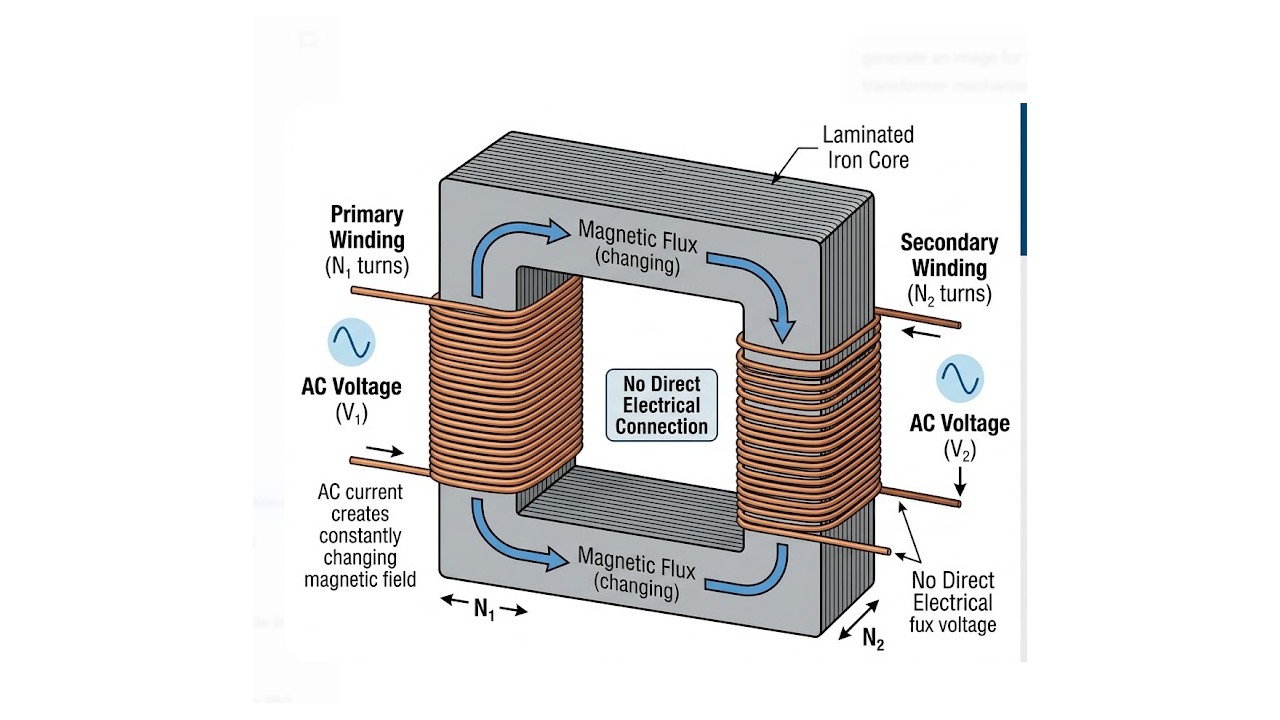
The process starts when an AC voltage is applied to the primary winding, which is a coil of wire wrapped around a magnetic core. This AC current creates a constantly changing magnetic field, called magnetic flux, inside the core. The core is usually made of thin sheets of iron stacked together, and it guides the magnetic flux with very little loss. This flux then travels through the core to reach the secondary winding, which is another coil of wire.
As the changing flux passes through the secondary winding, it creates an AC voltage there. No direct electrical connection exists between the two windings.
For more detail, you can explore the fundamental principles of electromagnetic induction.
The ratio of input voltage to output voltage depends on the turns ratio. This is simply the number of wire turns in the primary winding divided by the number of turns in the secondary winding.
The formula is: V₁/V₂ = N₁/N₂.
- If the secondary winding has more turns than the primary, the output voltage is higher, making it a step-up transformer.
- If the secondary has fewer turns, the output voltage is lower, making it a step-down transformer.
A basic diagram would show three main parts: the primary winding where input voltage enters, the laminated iron core that guides the magnetic flux, and the secondary winding where output voltage is produced.
What are electrical transformer internal components
Knowing what is a transformer made of helps you understand how it performs and how long it lasts. Each part has a specific job in handling electrical energy, magnetic fields, and heat. Here is a breakdown of the main components.
- Core: This is the heart of the transformer. It gives the magnetic flux a path to travel through and is built from thin, stacked sheets of high-grade silicon steel. This layered design cuts down on energy losses caused by eddy currents.
- Windings (Coils): These are the wire conductors that carry current. Transformers have at least two windings, a primary and a secondary. They are usually made from copper or aluminum and are insulated from each other and from the core.
- Insulating Material: Insulation stops short circuits and keeps the transformer safe.
- In oil-filled transformers, refined mineral oil acts as both an insulator and a coolant.
- Dry-type transformers use solid cast resin or other heat-resistant materials instead.
- Tank: This is the outer shell that holds the core, windings, and insulating fluid. It protects the internal parts from the environment and physical damage. It must stay sealed so that moisture cannot get into the insulating oil.
- Bushings: These are insulated terminals that connect the internal windings to the external power lines. They are typically made of porcelain or polymer to safely carry electricity through the grounded tank wall.
- Cooling System: All transformers produce heat because no energy transfer is perfectly efficient. A cooling system removes this heat and prevents damage.
- Simple designs use fins or radiators on the tank, known as ONAN (Oil Natural Air Natural).
- More demanding situations call for fans or pumps, known as ONAF (Oil Natural Air Forced) or OFAF (Oil Forced Air Forced).
What are different types of electrical transformers
The word “transformer” covers a large family of devices, and each one is built for a specific job. Sorting them into groups makes it easier to understand what each type does and where it fits in the electrical grid.
Classification by Applications
- Power Transformers: These are large, high-voltage units used in transmission networks. They work at voltages above 33kV and move bulk power between generating stations and major substations. Their main design goal is high efficiency at or near full load.
- Distribution Transformers: These units work at lower voltages, typically below 33kV, and are found closer to homes and businesses. They step down voltage for use in neighborhoods, commercial buildings, and factories. They are built to stay efficient even when the load changes throughout the day.
- Instrument Transformers: This group is not used for moving large amounts of power. Current Transformers (CTs) and Voltage Transformers (VTs) step down current and voltage to safe, standard levels for meters and protective relays.
Classification by Phase
- Single-Phase Transformers: These have one primary and one secondary winding. They are common for powering homes and small businesses, such as the units you see on utility poles.
- Three-Phase Transformers: These handle three-phase power and are the standard for factories, data centers, and the main power grid. They are very efficient at delivering large amounts of power.
Classification by Core Construction
- Core Type: The windings wrap around a large part of the core. This design is generally cheaper and works well for smaller, lower-voltage transformers.
- Shell Type: The core wraps around a large part of the windings. This gives the windings better physical support against the forces created during a short circuit and is often used for larger, higher-voltage transformers.
A clear way to compare these different types of transformers is with this table.
| Transformer Type | Primary Application | Typical Voltage Level | Key Characteristic |
|---|---|---|---|
| Power Transformer | Bulk Power Transmission | > 33 kV | High efficiency at full load |
| Distribution Transformer | Local Power Distribution | < 33 kV | Optimized for variable loads |
| Instrument Transformer | Measurement & Protection | Varies | High accuracy |
| Autotransformer | Voltage Regulation | Varies | Single winding, not isolated |
How to Select the Right Transformer
Picking the right transformer is a critical decision that affects system performance, cost, and safety. This checklist gives engineers, buyers, and facility managers a clear framework to follow.
1. Define Your Power Requirements (kVA Rating): The kVA rating is the most important number to establish first. It tells you how much total power the transformer can deliver without getting too hot. Size it to handle the maximum expected load, and leave room for future growth.
2. Determine Voltage Levels: You need to specify the primary voltage, which must match the available supply, and the secondary voltage that your equipment needs. Also consider the winding setup, such as Delta or Wye, since this affects grounding and phase relationships.
3. Consider the Application Environment: The location of the transformer shapes many other choices. Will it be indoors or outdoors? Is space limited? Will it face extreme heat, cold, high altitude, or corrosive conditions? These factors determine what kind of enclosure and cooling system you need.
4. Evaluate Efficiency and Losses: A more efficient transformer costs less to run over its lifetime. Two key numbers to compare are no-load losses, which happen in the core all the time, and full-load losses, which happen in the windings when current flows. Modern transformers must meet strict efficiency standards that lower the total cost of ownership over time.
5. Choose the Right Cooling Method: The cooling system must match the expected load and the local climate. Simple ONAN cooling works fine for smaller units. Larger transformers may need ONAF or OFAF systems with fans and pumps to handle more heat.
6. Assess Safety and Environmental Factors: Dry-type transformers are often the better choice for indoor or environmentally sensitive locations because they have no oil to spill and are safer in case of fire. Oil-filled transformers, on the other hand, often cool better and last longer in outdoor substation settings.
Once you have worked through this checklist, the next step is to match your needs with available products. Browse our comprehensive catalog of transformers to find models that fit your voltage, kVA, and application requirements.
Conclusion: The Indispensable Core
From the basic idea of electromagnetic induction to the details of selection and maintenance, the electrical transformer is a true engineering achievement. It is the essential component that makes our entire global power grid work.
This guide has covered how transformers function, what parts they contain, how the different types of transformers are classified, and the practical steps for choosing and caring for one. Anyone working in the power industry needs to understand these ideas. A transformer’s ability to reliably change voltage levels is the foundation of modern power delivery, allowing electricity to travel vast distances and arrive safely at every home and business.


