 CNC ELECTRIC GROUP ZHEJIANG TECHNOLOGY CO.,LTD
 Products
 Projects
 Solutions
 Service
 News
News About CNC
 Contact Us
Working with high-voltage equipment like a transformer breaker is dangerous. One mistake can hurt people or destroy machinery.
The kirk key system is a type of trapped key interlock system that keeps workers safe. It forces operators to follow a set sequence of steps before they can access any equipment.
Its main job is to make sure equipment is fully shut off before anyone opens a panel or door. This is done through a simple, non-electric system of locks and keys.
Critical High-Voltage Safety
Operating switchgear or transformers the wrong way can seriously hurt people and damage equipment. These risks are real, and engineers must design systems to prevent them.
The main dangers include:
- Arc Flash: A violent burst of energy that causes severe burns and a powerful pressure wave.
- Electrocution: Direct contact with live parts that can kill.
- Equipment Damage: Repairs can cost millions of dollars and shut down operations for a long time.
Human error, like skipping a step or opening the wrong panel, is one of the top causes of electrical accidents. Protecting these critical components in power distribution is a core responsibility for any engineer.
Engineered controls, not just warning signs, are what truly prevent these accidents. This is why well-built transformers are designed with safety in mind, often including support for interlock systems.
If you are choosing equipment, making sure it works with these safety schemes is not optional. Explore our range of safety-conscious transformers designed for modern grid applications.
Typical Interlock Sequence
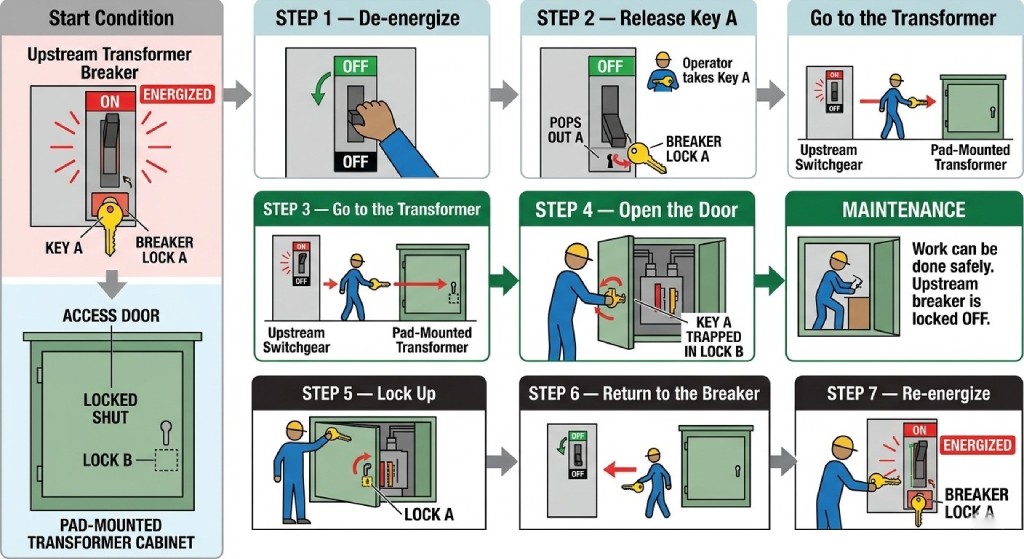
To see how a kirk key system works, consider a common task: doing maintenance on a pad-mounted transformer fed by an upstream transformer breaker. The goal is to safely open the transformer cabinet after confirming the power source is locked out.
Here is how the steps work:
- Start Condition: The transformer breaker is ON, and power is flowing to the transformer. Key A is trapped inside the breaker lock. Lock B on the transformer’s access door is empty and locked shut.
- Step 1 — De-energize: The operator turns the transformer breaker to the OFF position, cutting off power flow.
- Step 2 — Release Key A: Turning the breaker off releases Key A from the breaker lock. The operator can now take the key. The breaker is now locked in the OFF position and cannot be turned back on without Key A.
- Step 3 — Go to the Transformer: The operator brings Key A to the pad-mounted transformer cabinet and puts it into Lock B on the access door. This cabinet holds the various components of pad-mounted switchgear.
- Step 4 — Open the Door: Turning Key A in Lock B pulls back the bolt and opens the door. While the door stays open, Key A is trapped in Lock B.
- Maintenance: Work can now be done safely inside the cabinet. The upstream breaker cannot be turned on because Key A, the only key that can unlock it, is trapped at the transformer.
- Step 5 — Lock Up: When the work is done, the operator closes and locks the transformer access door. This releases Key A from Lock B.
- Step 6 — Return to the Breaker: The operator carries Key A back to the upstream switchgear.
- Step 7 — Re-energize: Inserting Key A into the transformer breaker lock lets the operator turn the breaker back ON. Key A is trapped again, and the system is back to its normal, energized state.
Core System Components
A kirk key system uses a small number of tough, simple parts that must work in a specific order. Each part is built to hold up in industrial settings.
The parts chosen for a system depend on the equipment and the safety steps required.
| Component | Function | Common Types |
|---|---|---|
| Key | The transfer device. Uniquely coded to work with a specific lock or set of locks. | Brass or stainless steel, various head shapes. |
| Lock Body | The housing that holds the locking mechanism. Mounted directly on the equipment. | Deadbolt, access lock, rotary lock. |
| Lock Bolt | The physical part that blocks an action, such as stopping a handle from moving or keeping a door shut. | Plunger, rotating cam, sliding bolt. |
Systems can be set up in many ways. Bolt locks are common for doors and panels, while rotary locks work well for switches and valve handles. Understanding the proper installation procedures is key to making sure these parts work together as a reliable safety system.
The exact parts used will depend on the equipment being interlocked. For example, the lock needed for a substation transformer’s access hatch is different from one used on a circuit breaker handle. When specifying new transformers, it is important to think about these integration points early in the design process.
Real-World Best Practices
Running a kirk key system well over time takes careful attention and strict habits. Small mistakes in managing the system can create serious safety gaps.
Installation and Commissioning
Always follow the manufacturer’s installation steps exactly. One of the most common mistakes is misaligning the lock bolt, which causes it to bind and stick.
Before putting a system into service, run through the full sequence at least a dozen times to make sure every key moves smoothly and every lock engages without force.
A key that feels stiff or hard to turn is a warning sign that must be fixed right away.
Maintenance and Lubrication
These are mechanical systems, so they need regular checks. Inspect for smooth operation and apply a small amount of the right non-conductive lubricant, as the manufacturer recommends. Guidance on this is often found in documentation covering industry-standard specifications.
Managing Lost or Damaged Keys
A lost or damaged key means the safety system is broken and must be treated that way. Never try to get around or defeat an interlock.
The correct action is to contact the manufacturer for a replacement key or, in many cases, a full replacement lock set to keep the unique coding intact.
Conclusion
The lasting value of the kirk key system comes from how simple and reliable it is. It enforces safe steps through physical, mechanical means, which removes the chance for human error in high-risk situations.
Unlike electronic systems, it cannot be taken down by a power outage, a software bug, or a cyberattack. Its rules are built into metal and cannot be overridden.


